Impact Highlights Include:
- Developed nearly a dozen rapid threat assessments for regional partners for use in their campaigns in Central Africa, Amazonia, and Southeast Asia
- Presented threat assessments to a wide range of foreign ministries in North America, Europe, Asia, and Latin America and finance and policy stakeholders in a spectrum of institutions
- Developed and helped adopt IUCN Motion 140 focused on averting irreversible ecological damage and tipping points in the Congo Basin
- Generated over 1000 stories featured in Tier 1, high profile, regional and other news outlets featuring partners, issues, and research. View some of our latest news coverage here
The results of our work can be explored in our 2025 Impact Report
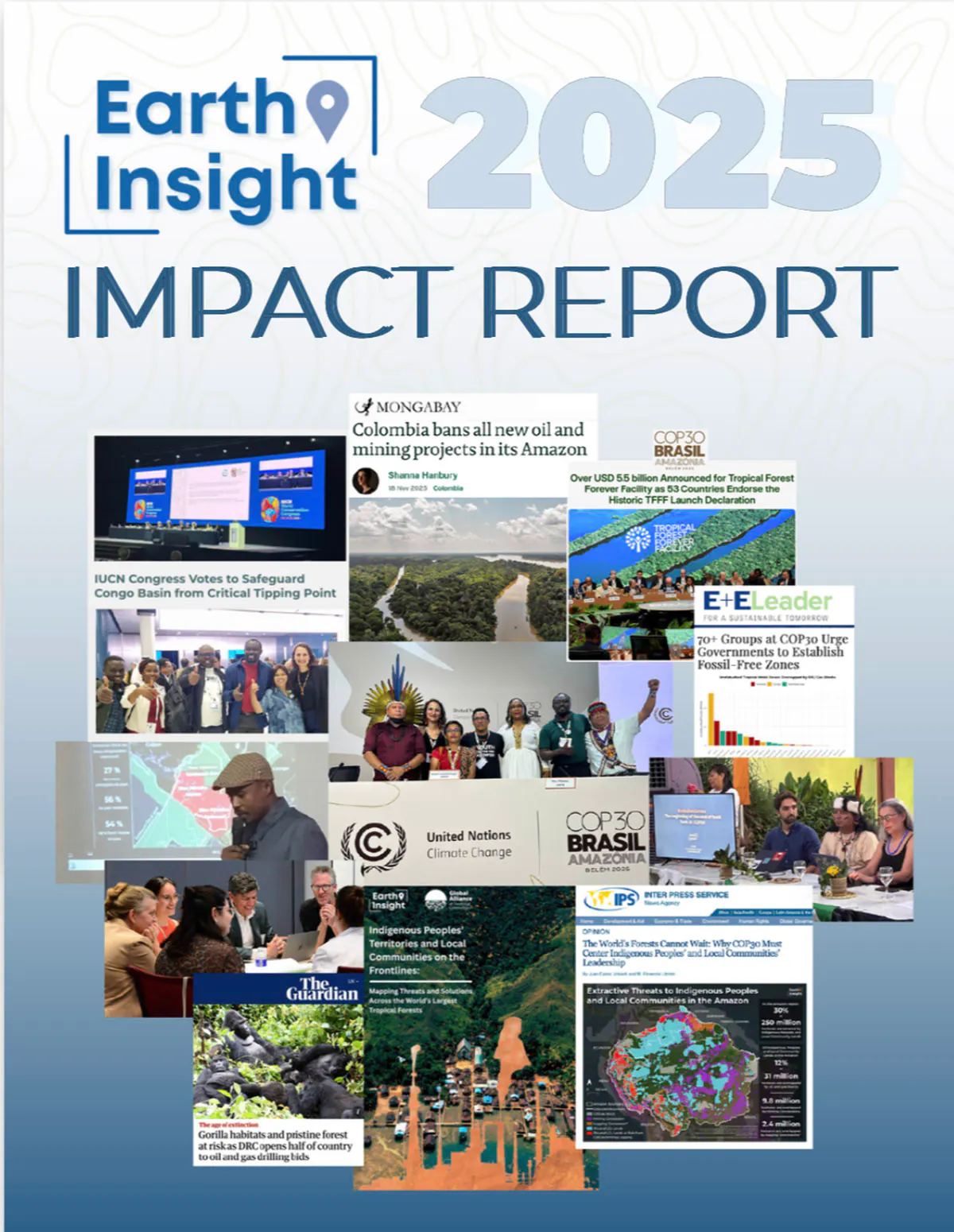
2025 was pivotal year for Earth Insight in advancing impact at the critical intersection of nature, climate and people. Through cutting-edge research, strategic communication and engagement, and capacity building, we have strengthened global and local efforts to restrict fossil fuel and extractive industry expansion in vital ecosystems.
2026
July 19, 2026: New spatial analysis released by Earth Insight, Auriga Nusantara, and AMAN demonstrates expanded deforestation linked to biomass haul zones from Indonesia's wood pellet and wood chip industry, placing further pressure on tropical forests, Key Biodiversity Areas, and Indigenous territories, including the customary forest of the Polahi, an Indigenous people living in voluntary isolation in Gorontalo, Sulawesi. The findings are released ahead of the Japan–Indonesia Forest Conservation Symposium 2026: The Future of Supply Chains for Zero Deforestation, to be held July 22–23 July in Tokyo, and hosted by a coalition of Japanese and Indonesian civil society organizations including Auriga Nusantara and the Global Environmental Forum (GEF) Japan.
June 24, 2026: We convened a partner round table discussions on KMGBF Target 3 & Intergovernmental Land Tenure Commitment (ILTC). This event, held during London Climate Action Week was done in collaboration with the KBA Secretariat, Campaign for Nature, the Global Alliance of Territorial Communities (GATC), the Rainforest Foundation UK, the Climate and Land-Use Alliance (CLUA), the Rights and Resources Initiative (RRI), and Rockefeller Brothers’ Fund.
June 4, 2026: In partnership with twelve civil society organizations from around the world, we released a report revealing that a new wave of offshore oil, gas, and LNG expansion is advancing directly into some of the planet's most ecologically critical and legally protected marine regions. Fossil Fuel Threats to the Ocean: Marine Life and Coastal Communities at Risk draws on geospatial analysis across eleven case studies – spanning Kenya, Tanzania, Cameroon, Norway, Alaska, Jamaica, Trinidad and Tobago, Argentina, Mexico, Indonesia, and Australia – to document how planned and active fossil fuel infrastructure overlaps with Protected Areas, Key Biodiversity Areas, Important Marine Mammal Areas, and Ecological or Biologically Significant Areas that include coral reefs, whale migration corridors, and the fishing grounds that coastal and Indigenous communities have depended on for generations.
May 27, 2026: We released a new report documenting compounding threats to one of Africa's most vital freshwater systems as construction of the East African Crude Oil Pipeline (EACOP) reaches 80% completion. Headwaters at Risk: How EACOP's Final Stages Threaten East Africa's Freshwater Lifelines reveals that the world's longest heated crude oil pipeline — spanning 1,443 kilometers — cuts through one of Africa's most extensive, ecologically interconnected freshwater systems and has already been implicated in flash flooding, water pollution, soil dumping on community land, and the loss of local water sources across eight of ten affected districts.
May 6, 2026: We released a report documenting mounting threats to a proposed 16-million-hectare territory along Brazil and Peru’s western Amazon, home to the world’s largest known population of Indigenous Peoples in Voluntary Isolation and Initial Contact (PIACI). Vanishing Footprints: The Race to Protect Isolated Indigenous Peoples in the Amazon’s Yavari-Tapiche Corridor was co-authored by the Regional Organization of Indigenous Peoples of the East (ORPIO), the Coordination of Indigenous Organizations of the Brazilian Amazon (COIAB), the Interethnic Association for the Development of the Peruvian Rainforest (AIDESEP), and Earth Insight.
April 15, 2026: Earth Insight, in collaboration with four partner organizations, held a press briefing & webinar on Fossil Free Zones ahead of the First International Conference on Transitioning Away from Fossil Fuels in Santa Marta, Colombia. Indigenous leaders and leading climate finance and policy experts convened in an online press briefing to call on governments worldwide and the financial sector to establish Fossil-Free Zones (FFZs). Panelists from Earth Insight, GATC, LINGO, Stand.earth, Fossil Fuel Treaty Initiative, and the CIEL, participated.
2025
November, 2025: Released an open letter at COP30, signed by over 100 international organizations, urging governments worldwide to establish fossil-free exclusion zones to protect high-integrity forests and uphold the rights of Indigenous Peoples and local communities. The call comes as newly released maps reveal the overlap of oil and gas blocks across more than 183 million hectares of tropical forests in the Amazon, Congo Region, and Southeast Asia.
November 2025: Earth Insight’s ministerial and civil society engagement supported Colombia’s unprecedented announcement at COP 30 to ban all new oil and mining projects in its Amazon Biome. The measure aims to protect at least 13 million hectares, more than 25% of the Amazon region in Colombia, covered by yet unlicensed oil blocks.
November 2025: in partnership with Global Alliance of Territorial Communities (GATC), we launched Indigenous Peoples' Territories and Local Communities on the Frontlines (watch the video here).
October 2025: Earth Insight worked with Members of the International Union for Conservation of Nature (IUCN) to draft an emergency motion focused on averting irreversible ecological damage and tipping points in the Congo Basin, the world's second-largest rainforest and a vital carbon sink. The motion, advanced by over 30 organizations from Africa, Latin America and North America, was adopted and calls for maintaining at least 74% forest intactness to prevent irreversible disruption of the region’s hydrological and climate-regulating systems.
September 2025: Red Alert: Nickel Mining Threats to Raja Ampat, launched with partners Auriga Nusantara on September 25th, 2025.
September 2025: Escalating Oil Exploration Threats to Conkouati-Douli National Park in Republic of Congo, launched with partners Centre d'Actions pour le Développement (CAD).
August 2025: Oil and Gas Expansion in the Colombian Amazon: Navigating Risks, Economics, and Pathways to a Sustainable Future, launched In Advance of Amazon Cooperation Treaty Organization (ACTO) Summit, on August 19th, 2025.
July, 2025: Forests to Frontlines: Oil Expansion Threats in the DRC, released in partnership with DRC-based groups Our Land Without Oil and CORAP, as well as Rainforest Foundation UK.
June 2025: Ocean Frontiers at Risk: Fossil Fuel Expansion Threats to Biodiversity Hotspots and Climate Stability released June 4, 2025 days before the Oceans Conference (UNOC) hosted in France.
Dive into our 2024 Impact Report for an in-depth look at the results of our work
At Earth Insight, striving for impact is what motivates our team.
We advance and fortify movement infrastructure and develop key tools that serve as levers to advance policy change and generate global issue visibility. In just the past three years, Earth Insight has:
- Developed threat maps and analyses of fossil fuel and industrial expansion across more than 1.7 billion hectares of tropical forests in more than 20 countries.
- Built direct funding and research partnerships with more than a dozen regional, Indigenous and international organizations working in the Amazon and Congo basins, and Southeast Asia
- Completed and launched research and advocacy tools that are being used within the civil society movement and informing financial institutions and bilateral and multilateral engagement.
October 2024: Coral Triangle at Risk: Fossil Fuel Threats & Impacts released at a UN press conference during Cop 16 in Cali, Colombia on October 26, 2024
October 2024: Closing Window of Opportunity: Mapping Threats to Important Areas for Conservation in the Pantropics released at a UN press conference during Cop 16 in Cali, Colombia on October 21, 2024
October 2024: Unheeded Warnings: Forest Biomass Threats to Tropical Forests in Indonesia and Southeast Asia launched during the Summit of Southeast Nations (ASEAN) on October 10, 2024
June 2024: Anything But Natural Liquefied Natural Gas (LNG) Infrastructure Expansion Threats to Coastal Areas released ahead of World Oceans Day on June 8, 2024
2022-23
December 2023: Losing Ground Report on Fossil Fuel Threats to Protected Areas released at a UN Press Conference at COP 28 in Dubai with partners including the World Commission on Protected Areas and LINGO
October 2023: Three Basins Threat Report launched with global partners from each of the forest basins for the Summit of the Three Basins in Brazzaville, Republic of Congo
December 2022: Crisis Point: Fossil Fuel Threats to Amazon and Congo basins launched at Biodiversity COP 15 in Montreal with partners
November 2022: Congo in the Crosshairs launched by African partners at the UNFCCC COP 27 in Sharm el-Sheikh, Egypt
We aim to address movement gaps and needs and advance ambitious policy interventions and invite you to join us in shaping this work.